
The aircraft that stays up.
The aircraft for corridor inspection from the air is called TENEO|E. A hybrid of lifting gas, shape and two motors. As long as a car, fully electric, with a UHD camera and LiDAR on board.
- 5 mlong
- 2.5 mwide
- 12 hairborne
- 2vectoring motors
- 100 %electric
Why does it work?
A multicopter treads water: it burns almost all its energy just to stay up. A fixed-wing aircraft can never stop. TENEO|E does neither. The lifting gas carries it, the wide, flat shape carries along once it moves, and two vectoring motors push and steer. That is why it stays up from dawn to dusk, quietly and without exhaust. If the power fails, the lifting gas holds it: it sinks, it does not fall. Little energy in flight, no rotors near the ground, which is why it can get the permit to fly over built-up areas.
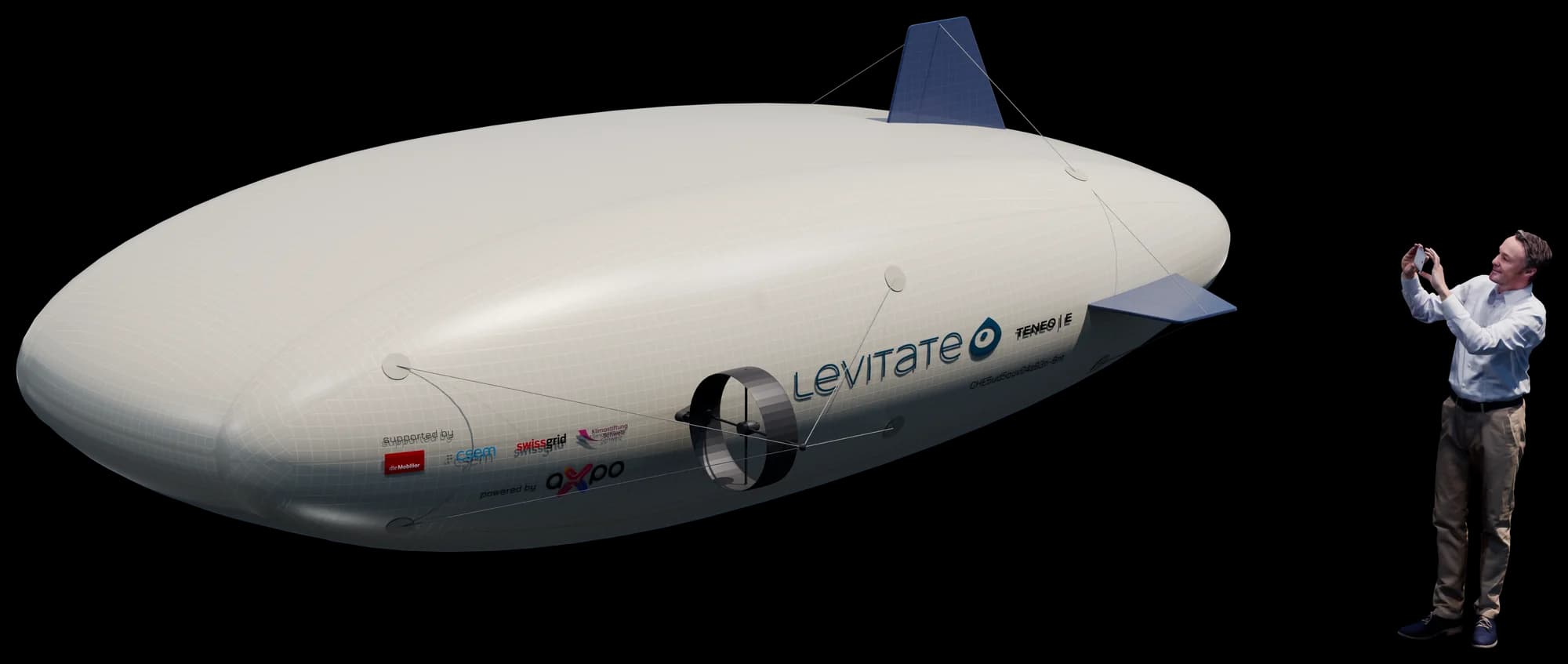
TENEO|E · 5 m · lifting gas + aerodynamics · 12 h
All the way round.
Dual-skin envelope, two gas cells, two vectoring motors and the LTE link: TENEO|E from the outside and the inside.
How we know it works.
May 2024
The idea on the Niesen
On the way up, in the middle of a conversation about gravity and battery life.
2024 to 2025
Several prototypes
Every prototype a step closer to today's shape.
September 2025
ELP6 flies
The big prototype, eight metres long, flies. The flight physics match the calculation.
2026
Calculated and built
Every motion of the aircraft is an equation, from crosswind to centre of gravity. The hull is built. With CSEM we're fitting it with 450 Wh/kg cells and solar.
October 2026
Maiden flight
A year after ELP6, TENEO|E takes off for the first time.
What's on board.
UHD camera
For the picture that shows every bolt.
LiDAR
The point cloud we compare from one flight to the next.
Optional
Thermal, and green LiDAR that measures below the water surface.
Autonomous
Designed to follow the track or the line. Telemetry over LTE.
Operations
We fly as the operator with our own permit. From a hub that reaches 150 km.
Built in house, run by software.
Hull, propulsion, electronics and software are all our own. Every change goes through the same loop: simulate, build, fly, compare. AI agents drive it.
Let's talk about your line.


Andi and Gabi make time for your corridor.